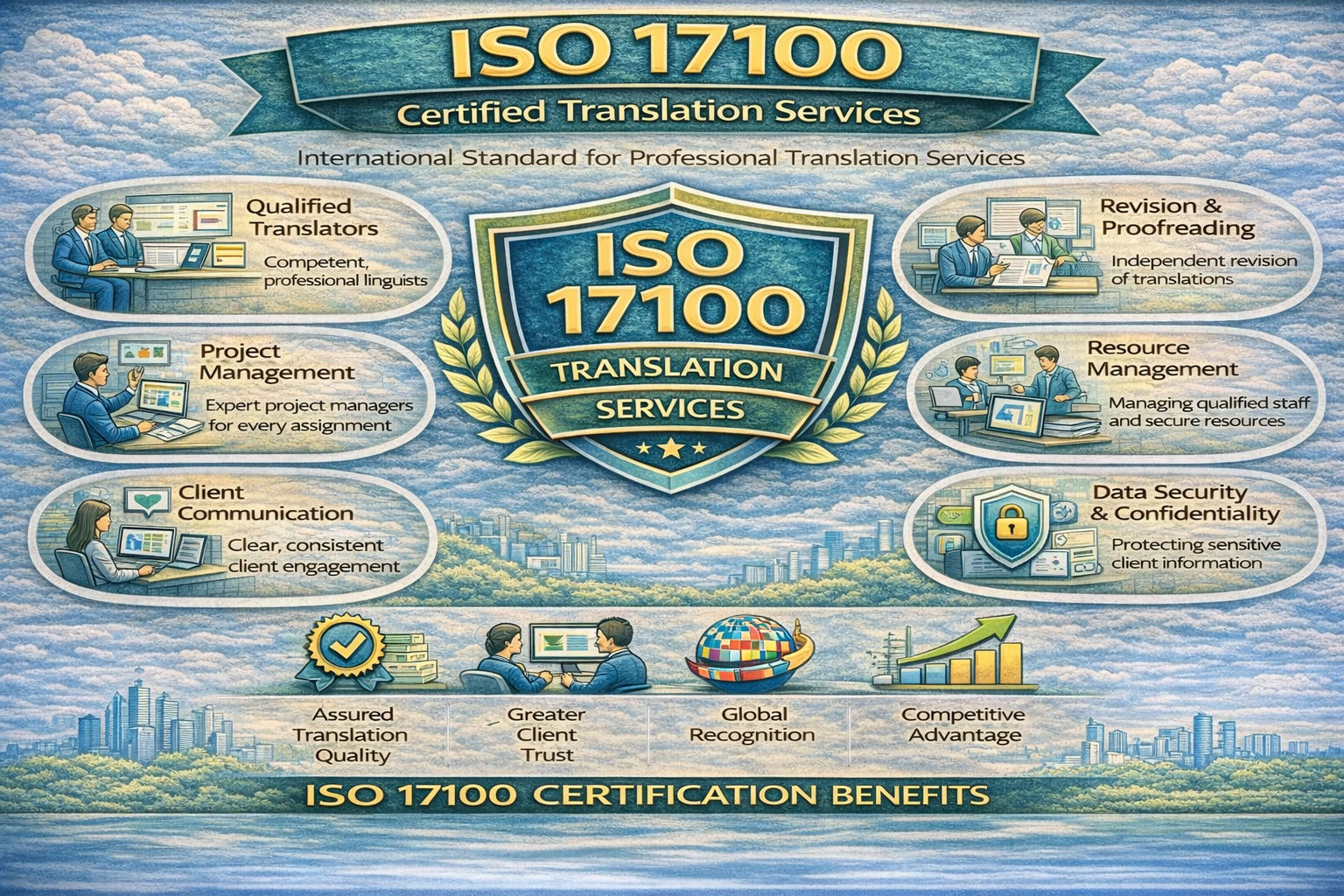
ISO 17100 – Translation Services Standard
What is ISO 17100 Certification?
ISO 17100 certification is an internationally recognized translation services standard that specifies requirements for delivering high-quality, professional translation services. The standard focuses on ensuring consistency, accuracy, competence, and reliability throughout the translation process.
ISO 17100 applies specifically to translation service providers (TSPs) and replaces the older EN 15038 standard. It defines requirements for translator qualifications, project management, quality assurance, and resource management, ensuring that translation services meet global quality expectations.
Importance of Translation Quality ISO 17100
In a globalized business environment, accurate and culturally appropriate translation is critical. Poor translation can lead to legal issues, reputational damage, and loss of customer trust. Translation quality ISO 17100 provides a structured framework to prevent these risks.
Key reasons organizations adopt ISO 17100 include:
-
Ensuring consistent translation quality
-
Reducing errors and misinterpretation
-
Improving client confidence and satisfaction
-
Meeting international and regulatory requirements
-
Demonstrating professionalism and credibility
ISO 17100 ensures that translation is treated as a controlled professional service, not just linguistic conversion.
Scope of Professional Translation Services
Professional translation services under ISO 17100 cover a wide range of content types, including:
-
Legal and contractual documents
-
Technical manuals and specifications
-
Medical and pharmaceutical content
-
Financial and business documents
-
Marketing and website localization
-
Software and multimedia translation
The standard applies to both written translation and related linguistic services such as revision, review, and proofreading (when included in the project scope).
ISO 17100 Requirements
Understanding ISO 17100 requirements is essential for effective implementation. The standard defines mandatory controls across the entire translation workflow.
1. Translator Qualifications
Translators must meet defined competence criteria, such as:
-
Recognized translation degree, or
-
Equivalent professional experience, or
-
Documented translation competence
This ensures only qualified professionals handle translation work.
2. Project Management
Each translation project must be managed by a competent project manager responsible for:
-
Defining project requirements
-
Selecting qualified translators and revisers
-
Ensuring timelines and quality controls
-
Managing client communication
3. Translation Process
ISO 17100 mandates a structured translation process, including:
-
Translation by a qualified translator
-
Mandatory revision by a second qualified linguist
-
Final verification before delivery
This two-step process is a core requirement of translation quality ISO 17100.
4. Review & Quality Assurance
All translations must undergo independent revision to ensure:
-
Accuracy and completeness
-
Terminology consistency
-
Style and language appropriateness
-
Compliance with client requirements
5. Resource Management
Translation service providers must maintain:
-
Qualified human resources
-
Secure IT systems and tools
-
Terminology databases and translation memories
-
Confidentiality and data protection controls.
6. Client Communication & Contracts
Clear communication is required regarding:
-
Project scope and expectations
-
Pricing and timelines
-
Confidentiality agreements
-
Change management
Transparency ensures trust and client satisfaction.
7. Data Security & Confidentiality
ISO 17100 requires strict protection of client information, including:
-
Confidentiality agreements
-
Secure file handling
-
Controlled access to project data
This is especially important for legal, medical, and corporate translations.
ISO 17100 Certification Process
The typical ISO 17100 certification process includes:
-
Gap Analysis
Assess current translation processes against ISO 17100 requirements. -
Process Development
Document translation workflows, quality checks, and roles. -
Resource Qualification
Verify translator, reviser, and project manager competencies. -
System Implementation
Apply quality controls across all translation projects. -
Internal Audit
Review compliance before certification. -
Certification Audit
External audit by an accredited certification body. -
Benefits of ISO 17100 Certification
-
Improved translation quality and consistency
-
Increased client trust and satisfaction
-
International recognition and credibility
-
Reduced errors and rework
-
Competitive advantage in global markets
-
Compliance with professional translation standards
ISO 17100 certification demonstrates commitment to excellence in translation services.
Who Should Implement ISO 17100?
ISO 17100 is ideal for:
-
Translation agencies
-
Language service providers (LSPs)
-
Localization companies
-
Corporate in-house translation teams
-
Freelance translators working through certified agencies
Any organization delivering professional translation services can benefit from ISO 17100.
Why Choose ISO 17100 Consultancy Services?
Professional ISO 17100 consultancy helps organizations:
-
Understand complex standard requirements
-
Qualify translators and resources correctly
-
Design compliant translation workflows
-
Reduce audit non-conformities
-
Achieve certification faster and smoothly
Expert support ensures practical and sustainable compliance.
Frequently Asked Questions (FAQs)
1. What is ISO 17100 certification?
ISO 17100 certification confirms that a translation service provider meets international requirements for quality translation services.
2. Is ISO 17100 mandatory?
ISO 17100 is not legally mandatory, but it is widely required by international clients and organizations.
3. Does ISO 17100 apply to freelance translators?
ISO 17100 applies to translation service providers, but freelancers can work under ISO 17100-certified agencies.
4. What is the difference between ISO 17100 and ISO 9001?
ISO 9001 is a general quality management standard, while ISO 17100 is specific to translation services, with defined linguistic quality controls.
5. How long does ISO 17100 certification take?
Typically 2–4 months, depending on organization size and readiness.
-