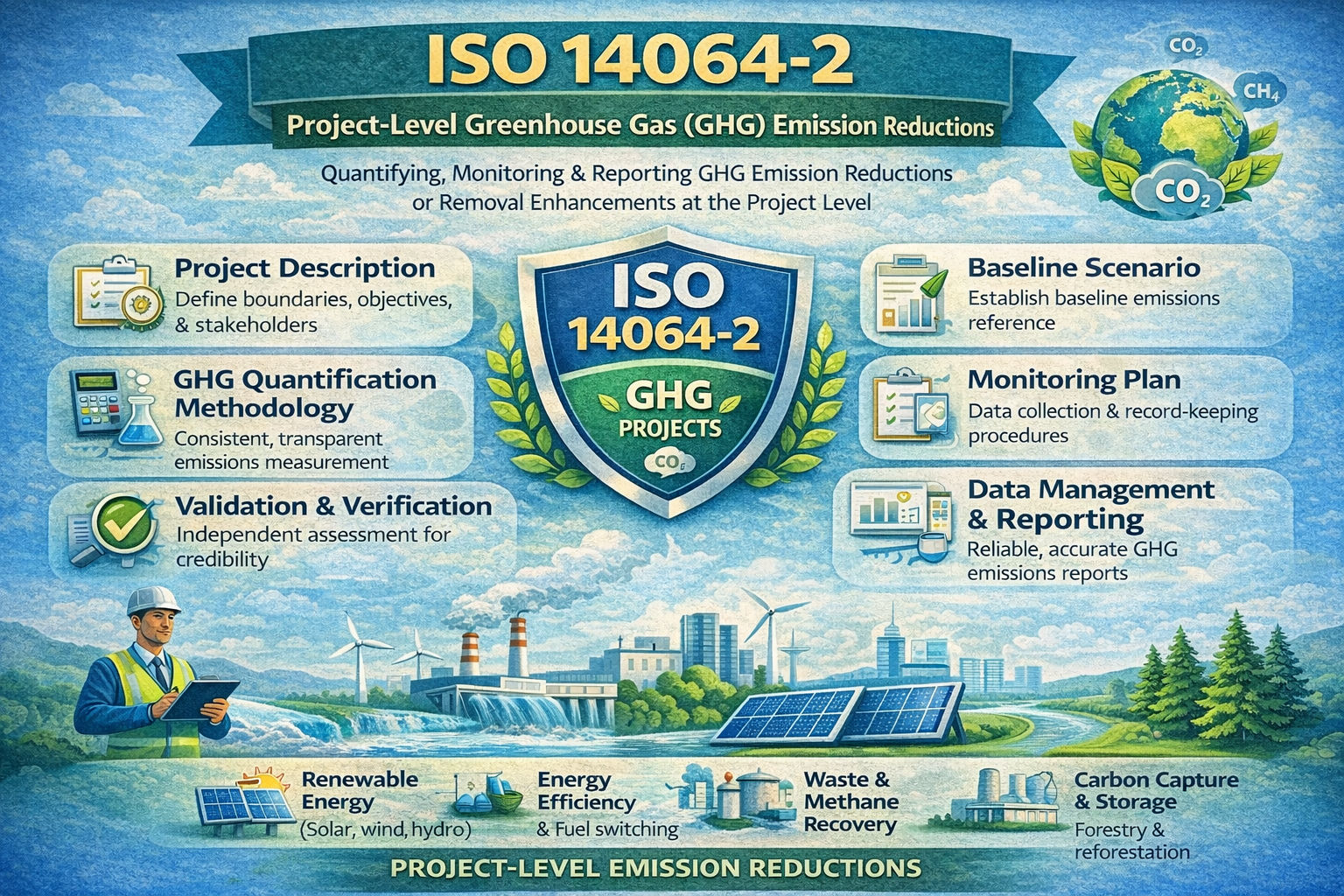
ISO 14064-2 – Project-Level Greenhouse Gas (GHG) Emission Reductions
What is ISO 14064-2?
ISO 14064-2 certification is an internationally recognized standard that provides a framework for quantifying, monitoring, and reporting greenhouse gas (GHG) emission reductions or removal enhancements at the project level. It is designed for organizations implementing climate-related projects that aim to reduce, avoid, or remove GHG emissions.
ISO 14064-2 ensures that emission reduction claims are accurate, consistent, transparent, and credible, enabling stakeholders, regulators, and investors to trust reported climate impacts.
Importance of ISO 14064-2 Certification
As climate change regulations and sustainability commitments increase globally, organizations must demonstrate the real impact of their emission reduction projects. ISO 14064-2 GHG project quantification provides a robust methodology to measure and report emissions in a standardized manner.
Key objectives of ISO 14064-2 include:
-
Credible measurement of emission reductions
-
Transparent and consistent reporting
-
Support for carbon markets and climate programs
-
Improved confidence in environmental claims
-
Alignment with international climate frameworks
Scope of ISO 14064-2
Project-level greenhouse gas emissions ISO 14064-2 applies to projects such as:
-
Renewable energy (solar, wind, hydro)
-
Energy efficiency improvements
-
Fuel switching projects
-
Waste management and methane recovery
-
Afforestation and reforestation
-
Carbon capture and storage (CCS)
The standard focuses on individual projects, not organizational or national GHG inventories.
Key ISO 14064-2 Requirements
Understanding ISO 14064-2 emission reduction reporting requirements is essential for compliance. The standard includes the following core elements:
1. Project Description
A clear definition of project boundaries, objectives, baseline scenario, and stakeholders.
2. Baseline Scenario
Identification of what emissions would have occurred without the project, forming the reference point for calculating reductions.
3. GHG Quantification Methodology
Selection of appropriate methods to quantify emissions, removals, and reductions in a consistent and transparent way.
4. Monitoring Plan
A documented plan defining how emissions data will be collected, measured, and recorded throughout the project lifecycle.
5. Data Management & Quality Control
Ensuring accuracy, completeness, consistency, and traceability of GHG data.
6. Reporting
Preparation of a GHG project report describing methodologies, assumptions, results, and uncertainties.
ISO 14064-2 Certification Process
The ISO 14064-2 certification process typically involves:
-
Gap Analysis
Review existing project documentation against ISO 14064-2 requirements. -
Methodology Development
Define baseline, boundaries, and quantification methods. -
Monitoring System Implementation
Establish data collection and record-keeping processes. -
GHG Reporting
Prepare project-level GHG emission reduction reports. -
Validation & Verification
Independent assessment by accredited bodies for credibility and assurance.
Relationship with Validation and Verification
ISO 14064-2 is closely linked with GHG validation and verification ISO 14064-2, where:
-
Validation confirms the project design and expected emission reductions.
-
Verification confirms actual emission reductions achieved.
These assessments enhance transparency and acceptance in voluntary and regulatory carbon markets.
Who Needs ISO 14064-2 Certification?
ISO 14064-2 is suitable for:
-
Project developers
-
Renewable energy companies
-
Sustainability and climate consultants
-
Carbon credit project owners
-
Organizations participating in carbon markets
Any entity implementing emission reduction or removal projects benefits from ISO 14064-2 compliance.
Business Benefits of ISO 14064-2
-
Credible emission reduction claims
-
Support for carbon credits and offset programs
-
Improved investor and stakeholder confidence
-
Alignment with global climate goals
-
Enhanced regulatory and market acceptance
-
Strong environmental credibility
By applying ISO 14064-2 GHG project quantification, organizations demonstrate measurable climate action.
Why Choose ISO 14064-2 Consultancy Services?
Professional consultancy support helps organizations:
-
Select correct quantification methodologies
-
Develop compliant monitoring and reporting systems
-
Prepare validation and verification documentation
-
Avoid errors and non-conformities
-
Achieve faster project approval
Expert guidance ensures reliable and audit-ready project documentation.
Frequently Asked Questions (FAQs)
1. What is ISO 14064-2 certification?
ISO 14064-2 certification confirms that a project’s GHG emission reductions or removals are quantified and reported using an internationally recognized framework.
2. Is ISO 14064-2 mandatory?
ISO 14064-2 is not legally mandatory, but it is widely required for carbon markets, sustainability reporting, and climate programs.
3. What types of projects use ISO 14064-2?
Renewable energy, energy efficiency, waste management, forestry, and carbon capture projects commonly use ISO 14064-2.
4. What is the difference between ISO 14064-1 and ISO 14064-2?
ISO 14064-1 applies to organizational GHG inventories, while ISO 14064-2 focuses on project-level emission reductions.
5. How long does ISO 14064-2 certification take?
Typically 2 to 6 months, depending on project complexity and data availability.