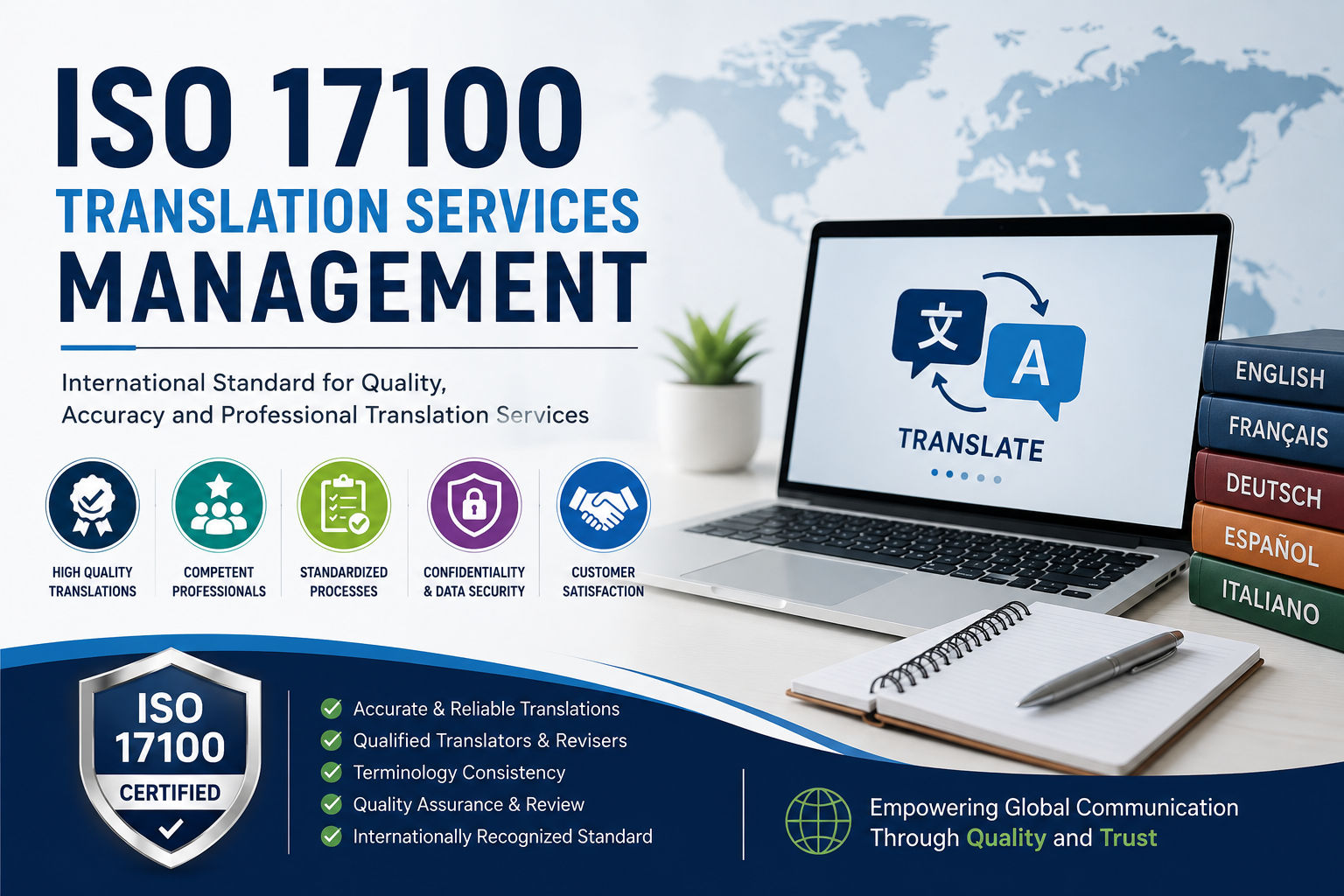
ISO 17100 Translation Services Management helps improve translation quality, consistency, compliance, and customer satisfaction.
In today's global business environment, organizations regularly communicate with customers, suppliers, employees, government authorities, and international partners across different languages. Accurate and professional translation is therefore essential for maintaining clear communication and protecting business reputation. ISO 17100 Translation Services Management provides an internationally recognized framework for managing the quality of translation services.
ISO 17100 focuses specifically on translation service providers and establishes requirements for the core processes, resources, and other aspects necessary to deliver high-quality translation services. Organizations that implement ISO 17100 can demonstrate their commitment to professional translation quality, consistency, confidentiality, and customer satisfaction.
What is ISO 17100?
ISO 17100 is an international standard that specifies requirements for translation service providers. It provides a structured approach to managing translation projects and focuses on the competencies, processes, resources, and quality requirements needed for professional translation services.
The standard helps translation service providers establish consistent processes from receiving a translation request through translation, revision, review, delivery, and post-delivery activities.
ISO 17100 Translation Services Management is particularly valuable for organizations handling technical, legal, financial, medical, marketing, educational, and other specialized content.
Why is ISO 17100 Important?
Translation errors can create significant risks for businesses. Incorrect terminology, missing information, poor formatting, or inaccurate translations can affect customer relationships, legal compliance, contracts, product information, and brand reputation.
Implementing ISO 17100 Translation Services Management helps organizations establish controlled and repeatable translation processes.
Key benefits include:
-
Improved translation quality
-
Consistent terminology
-
Better project management
-
Increased customer satisfaction
-
Qualified translation professionals
-
Improved quality control
-
Greater confidentiality
-
Enhanced business credibility
-
International recognition
An effective translation management system allows organizations to deliver reliable multilingual content consistently.
Key Requirements of ISO 17100
ISO 17100 covers several important areas associated with professional translation services.
Competent Translation Professionals
The standard emphasizes the importance of qualified translators, revisers, and other professionals involved in translation projects. Appropriate linguistic, subject-matter, and translation competencies help ensure that content is accurately translated.
Translation Process Management
A structured translation process helps organizations manage projects effectively. This includes reviewing requirements, assigning appropriate resources, carrying out translation, revision, review, and delivering the final content according to agreed requirements.
Quality Assurance
Quality control is an essential component of ISO 17100 Translation Services Management. Reviewing translated content helps identify errors and ensures that the final translation meets customer and project requirements.
Project Management
Translation projects require effective planning and coordination. ISO 17100 supports systematic management of deadlines, resources, client requirements, terminology, documentation, and communication.
Confidentiality and Data Protection
Translation projects can involve sensitive business information, contracts, technical documents, financial records, and personal information. Appropriate confidentiality practices help protect client information throughout the translation process.
Benefits of ISO 17100 Certification
Organizations implementing ISO 17100 Translation Services Management can gain several competitive advantages.
Improved Translation Quality
A structured management system ensures that translation activities follow defined processes, helping reduce errors and inconsistencies.
Increased Customer Confidence
Certification demonstrates that a translation service provider follows an internationally recognized standard for managing translation services.
Better Consistency
Standardized processes and terminology management help maintain consistency across multiple documents, languages, and projects.
Enhanced Professional Credibility
ISO 17100 certification can strengthen the reputation of translation companies and demonstrate their commitment to quality.
International Business Opportunities
Many organizations prefer working with service providers that follow internationally recognized standards. ISO 17100 can therefore support expansion into global markets.
Who Can Benefit from ISO 17100?
ISO 17100 Translation Services Management is particularly suitable for:
-
Translation companies
-
Language service providers
-
Localization companies
-
Multilingual content providers
-
Technical translation agencies
-
Legal translation providers
-
Medical translation companies
-
Financial translation service providers
-
Government translation service providers
-
International organizations
The standard can help both established translation businesses and growing language service providers strengthen their management systems.
ISO 17100 Implementation Process
Implementing ISO 17100 Translation Services Management requires a systematic approach. Intermax Consultancy can guide organizations through the certification journey.
1. Initial Assessment
The existing translation processes, resources, documentation, and quality controls are assessed to identify areas for improvement.
2. Gap Analysis
A detailed gap analysis identifies differences between current practices and ISO 17100 requirements.
3. Documentation
Required policies, procedures, processes, records, and quality controls are established according to organizational requirements.
4. Implementation
The documented processes are implemented across relevant translation activities and departments.
5. Training and Awareness
Employees and translation professionals are made aware of the requirements and their responsibilities within the management system.
6. Internal Audit
Internal audits help evaluate whether the implemented system is working effectively and identify areas requiring corrective action.
7. Certification Audit
The organization undergoes an external certification audit by an appropriate certification body. Successful completion can lead to ISO 17100 certification.
Why Choose Intermax Consultancy?
Intermax Consultancy provides professional consulting support for organizations seeking ISO 17100 Translation Services Management. Our consultants help businesses understand the standard, identify gaps, develop appropriate processes, and prepare for certification.
Our support can include:
-
ISO 17100 gap analysis
-
Documentation assistance
-
Translation process development
-
Quality management guidance
-
Employee awareness training
-
Internal audit support
-
Corrective action guidance
-
Certification audit preparation
We focus on practical implementation so organizations can integrate ISO 17100 requirements into their existing business processes.
ISO 17100 and Business Growth
Quality translation is more than simply converting words from one language to another. It requires accuracy, context, terminology management, cultural understanding, quality control, and professional project management.
By implementing ISO 17100 Translation Services Management, organizations can establish a reliable framework for delivering professional multilingual services. This can improve customer relationships, reduce translation-related risks, and strengthen competitiveness in international markets.
Conclusion
As businesses continue to expand internationally, the demand for accurate and reliable translation services is increasing. ISO 17100 Translation Services Management provides translation service providers with a structured framework for delivering consistent, professional, and high-quality translation services.
From qualified professionals and controlled processes to quality assurance and customer-focused project management, ISO 17100 helps organizations strengthen every stage of their translation operations.
Intermax Consultancy supports organizations throughout the ISO 17100 implementation and certification journey. With professional consulting, documentation, training, audit preparation, and continuous improvement support, businesses can build a stronger translation management system and demonstrate their commitment to international quality standards.