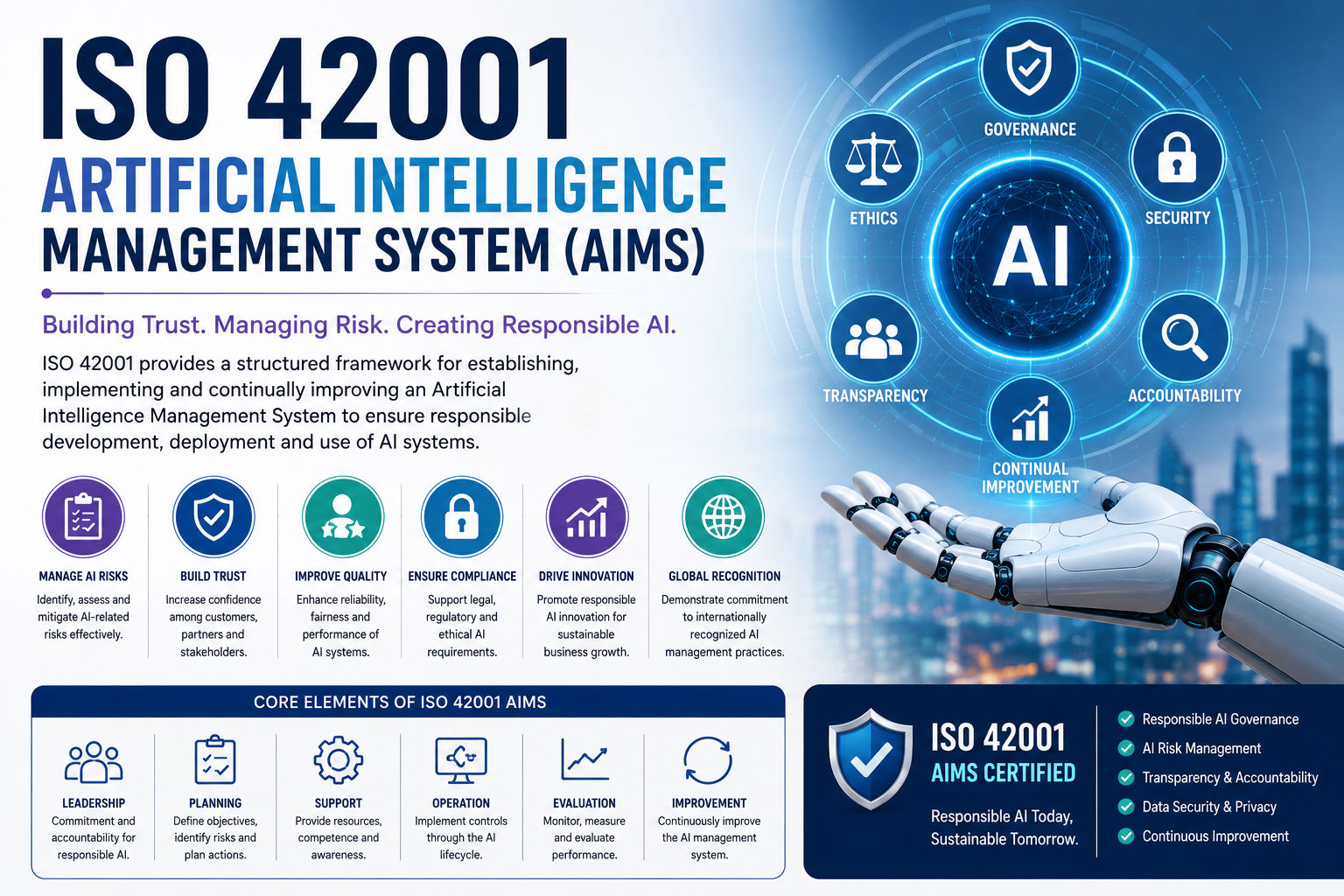
ISO 42001 AIMS helps organizations manage AI risks, improve governance, ensure compliance, and build responsible AI systems.
Artificial intelligence is transforming the way organizations operate, make decisions, serve customers, and develop new products and services. From generative AI and machine learning to automated decision-making and intelligent analytics, businesses are adopting AI across almost every industry. However, the rapid adoption of AI also creates new challenges related to privacy, security, bias, transparency, accountability, and risk management.
ISO 42001 Artificial Intelligence Management System (AIMS) provides organizations with a structured framework for managing these challenges. ISO/IEC 42001:2023 is the international standard for establishing, implementing, maintaining, and continually improving an Artificial Intelligence Management System. It is designed for organizations that develop, provide, or use AI-based products and services.
What is ISO 42001?
ISO 42001 is an international management system standard specifically designed for artificial intelligence. It helps organizations establish policies, processes, controls, and objectives for the responsible development, provision, and use of AI systems.
Unlike standards that focus on a specific technology, ISO 42001 provides an organization-wide management framework. It addresses AI-related risks and opportunities while supporting responsible innovation, transparency, reliability, and accountability.
An Artificial Intelligence Management System (AIMS) can cover AI activities throughout their lifecycle, including design, development, deployment, operation, monitoring, and continual improvement.
Why is ISO 42001 Important?
AI systems can provide significant business benefits, but they can also introduce risks if they are not properly managed. These risks may involve inaccurate outputs, biased decisions, privacy concerns, data quality, cybersecurity, lack of transparency, or unintended consequences.
Implementing ISO 42001 Artificial Intelligence Management System helps organizations take a systematic approach to identifying, assessing, treating, and monitoring AI-related risks.
The standard can help organizations:
-
Establish responsible AI governance
-
Identify and manage AI-related risks
-
Improve transparency and accountability
-
Strengthen data management practices
-
Support privacy and security
-
Increase stakeholder confidence
-
Improve AI system reliability
-
Support applicable legal and regulatory requirements
-
Encourage responsible AI innovation
ISO describes ISO/IEC 42001 as the world's first AI management system standard, providing a structured way to balance AI innovation with governance.
Ethical AI Governance
Responsible AI requires more than technical performance. Organizations must consider how AI affects people, customers, employees, and other stakeholders.
ISO 42001 Artificial Intelligence Management System supports ethical AI governance by addressing areas such as fairness, transparency, accountability, human oversight, responsible data use, and privacy.
Organizations can establish clear AI policies that define acceptable AI use, responsibilities, decision-making processes, and controls. This helps create greater trust among customers, employees, regulators, and business partners.
Artificial Intelligence Risk Management
AI-related risks can change throughout the lifecycle of an AI system. For example, risks may arise during data collection, model development, deployment, monitoring, or system updates.
ISO 42001 encourages organizations to establish a structured risk management approach. This includes identifying AI risks, evaluating their potential impact, implementing controls, and continuously monitoring effectiveness.
A proactive approach to Artificial Intelligence Risk Management can help organizations reduce unwanted outcomes while maximizing the benefits of AI technologies.
Key Requirements of ISO 42001
An effective ISO 42001 AIMS addresses several important areas, including:
Leadership and Commitment
Top management should demonstrate commitment to responsible AI governance and provide appropriate resources for implementing the management system.
AI Policy and Objectives
Organizations should establish AI-related policies and measurable objectives that align with their business strategy and responsible AI principles.
Risk Assessment and Controls
AI-related risks should be identified, assessed, treated, and monitored throughout relevant AI system lifecycles.
Data Management
Organizations need appropriate processes for managing data quality, integrity, security, privacy, and other relevant data considerations.
Human Oversight
Appropriate human involvement and accountability should be maintained where AI systems influence important decisions.
Operational Controls
Organizations should establish controls for the development, deployment, use, monitoring, and management of AI systems.
Performance Evaluation
The effectiveness of the AI Management System should be monitored, measured, reviewed, and evaluated.
Continual Improvement
Organizations should continually improve their AIMS based on performance results, audit findings, risks, opportunities, and changing AI requirements.
Who Should Implement ISO 42001?
ISO 42001 Artificial Intelligence Management System can be implemented by organizations of any size and across different industries. ISO specifically states that the standard is applicable to organizations providing or using products or services that utilize AI systems.
It can benefit:
-
Technology companies
-
Software development companies
-
AI and machine learning organizations
-
Healthcare organizations
-
Financial institutions
-
Manufacturing companies
-
Government organizations
-
Education providers
-
Retail businesses
-
Professional service providers
-
Organizations using generative AI
Whether an organization develops its own AI solutions or uses externally provided AI technologies, an AIMS can provide a structured governance framework.
ISO 42001 Implementation Process
Implementing an ISO 42001 Artificial Intelligence Management System generally involves several stages.
1. Gap Analysis: Assess existing AI governance practices against ISO 42001 requirements.
2. AI Governance Planning: Establish the scope, policies, objectives, roles, and responsibilities of the AIMS.
3. Risk Assessment: Identify and evaluate AI-related risks and establish appropriate controls.
4. Documentation and Implementation: Develop necessary processes, procedures, records, and operational controls.
5. Training and Awareness: Train employees and relevant stakeholders on responsible AI practices.
6. Internal Audit: Evaluate the effectiveness and conformity of the implemented AIMS.
7. Management Review: Review system performance, risks, opportunities, and improvement requirements.
8. Certification Audit: An independent certification body assesses conformity with the applicable ISO 42001 requirements.
Benefits of ISO 42001 Certification
Obtaining ISO 42001 Certification can demonstrate an organization's commitment to responsible AI management. It can help strengthen trust, improve governance, manage AI-related risks, and support compliance with applicable requirements.
The standard can also provide a competitive advantage for organizations operating in AI-driven markets by demonstrating that AI is being managed through a structured and accountable framework. ISO highlights responsible AI, reputation management, governance, risk management, and innovation as important benefits of implementing the standard.
Why Choose Intermax Consultancy?
Intermax Consultancy provides professional ISO 42001 Artificial Intelligence Management System consulting and certification support. Our services can help organizations understand the standard, assess their existing AI practices, establish appropriate governance processes, manage AI-related risks, and prepare for certification.
Our support includes:
-
ISO 42001 Gap Analysis
-
AIMS Documentation Support
-
AI Risk Management
-
AI Governance Guidance
-
Employee Awareness Training
-
Internal Audit Support
-
Management Review Guidance
-
Certification Audit Preparation
With a practical approach to implementation, organizations can integrate AI governance into their existing management systems while supporting responsible innovation.
Conclusion
Artificial intelligence offers enormous opportunities, but responsible management is essential for sustainable and trustworthy AI adoption. ISO 42001 Artificial Intelligence Management System (AIMS) provides organizations with a structured framework for managing AI risks, improving governance, supporting transparency, and promoting responsible innovation.
As businesses increasingly develop and use AI technologies, implementing ISO 42001 can help build confidence among customers, employees, regulators, and other stakeholders.
Intermax Consultancy can support organizations throughout their ISO 42001 Certification journey, from initial gap analysis and documentation to implementation, internal audit, and certification preparation. Build a responsible AI management framework and prepare your organization for a future driven by trusted and accountable artificial intelligence.